Did you hear?
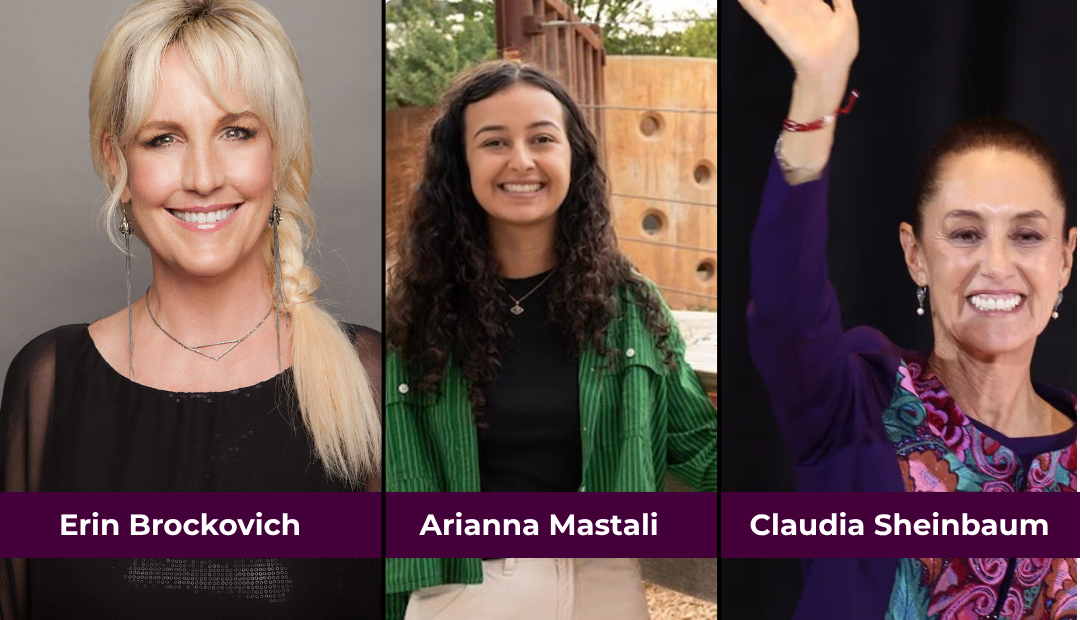
Erin Brockovich is still showing up for communities poisoned by corporate greed — 26 years after her landmark $333 million victory, a Georgia Tech Ph.D. student just invented an enrichment wall that plays music only elephants can hear and transformed how we think about animal wellbeing, and Claudia Sheinbaum — Mexico's first female president and a Nobel Prize-winning climate scientist — is already reshaping the country's energy future away from fossil fuels.
Let's dive into all the wins and stories worth celebrating:
Erin Brockovich Is Still Fighting for Clean Water 26 Years Later: Following her landmark 1996 victory securing a $333 million settlement against PG&E for contaminating Hinkley, California's groundwater with carcinogen chromium-6, Erin Brockovich has never stopped — spearheading anti-pollution lawsuits across Missouri, Texas, and New York, and most recently amplifying the voices of residents in Wayne County, West Virginia after thousands of gallons of oil contaminated their drinking water.
Claudia Sheinbaum: Mexico's First Female President Is Also a Climate Scientist: Claudia Sheinbaum, who took office on October 1, 2024, made history as both the first woman and the first Jewish person ever elected president of Mexico — and she brings with her a Ph.D. in energy engineering, a Nobel Peace Prize (shared with the IPCC in 2007), and a strong focus on renewable energy and climate-concious leadership. Unlike her predecessor, who propped up the petroleum industry, Sheinbaum has explicitly rejected that approach, pushing instead for nationally subsidized clean energy as a cornerstone of her presidency.
CopenHill Turned a Waste-to-Energy Plant Into a Ski Slope and a Symbol: Copenhagen's CopenHill, designed by Bjarke Ingels Group, is simultaneously the cleanest waste-to-energy plant in the world and a fully functional urban recreation center — its roof is a ski slope, its facade is climbable, and its furnaces convert 440,000 tons of waste annually into electricity and heating for 150,000 homes. Nearly a decade in the making, the project embodies what BIG calls "Hedonistic Sustainability" — the radical idea that a sustainable city isn't just better for the environment, it's more joyful for the people living in it.
Jaguars Return to Argentina After 70 Years of Absence: Seven decades after logging and poaching drove jaguars out of Argentina entirely, a young male named Ombú was spotted resting on a trail in Iberá National Park — the first wild jaguar sighting in the region since the 1950s. Thanks to relentless rewilding efforts by Rewilding Argentina alongside scientists, park rangers, and local ranchers, Corrientes province now has 50 free-roaming jaguars, nearly 20% of Argentina's entire jaguar population.
AI-Powered Cameras Are Now Watching San Francisco Bay to Protect Gray Whales From Ships: Scientists at the Benioff Ocean Science Laboratory, in collaboration with the Marine Mammal Center and the U.S. Coast Guard, have installed a network of AI-powered thermal cameras in San Francisco Bay that can detect gray whales around the clock — even in fog and darkness — and alert ship captains in real time to slow down or reroute.
College Students Built an Enrichment Wall That Plays Music Only Elephants Can Hear: Georgia Tech Ph.D. student Arianna Mastali designed an audio enrichment system for Zoo Atlanta's four African elephants — using computer vision to detect when a trunk enters a wall opening, then triggering low-frequency tones tuned specifically to elephant hearing ranges. After installation, elephant visits to the wall increased by 176% and time spent there jumped 71%, with one elephant documented lingering at the wall just to listen — even when there was no food involved.
A Nobel Prize-Winning Chemist Just Figured Out How to Pull Drinking Water From Thin Air:UC Berkeley professor and 2025 Nobel Prize winner Omar Yaghi has developed a solar-powered machine through his company Atoco that can extract up to 1,000 liters of clean drinking water per day directly from the atmosphere — even in desert conditions with humidity below 20%.
Copenhagen Built a Ski Slope on Top of a Power Plant: CopenHill, designed by Bjarke Ingels Group (BIG), is a waste-to-energy plant in Copenhagen that converts 440,000 tons of waste annually into electricity and heating for 150,000 homes — and doubles as a public recreation center with a 500-meter ski slope, hiking trails, and a climbing wall on its roof.
Two College Students Are Turning Recycled Glass Into Sand:
Tulane University graduates Franziska Trautmann and Max Steitz founded Glass Half Full NOLA, a New Orleans-based company that recycles approximately 100,000 pounds of glass every month — diverting over 3.2 million pounds from landfills — and pulverizes it into silica sand that mirrors the natural sediment of the Mississippi River Delta. With a $5 million National Science Foundation grant, they are now using that glass-sand to restore eroding wetlands at the Big Branch Marsh National Wildlife Refuge, where Louisiana loses the equivalent of a football field of coastline every 30 minutes.
Helicopter Food Drops Saved Endangered Wallabies After Australia's Catastrophic Bushfires:After the 2019-2020 Australian bushfires scorched more than 5.3 million hectares — destroying over 80% of the food sources for endangered brush-tailed rock-wallabies — the National Parks and Wildlife Service coordinated the aerial delivery of over 14,500 kilograms of carrots and sweet potatoes to more than a dozen isolated wallaby colonies across New South Wales. The carefully chosen food drops continued only until native vegetation began to recover, designed as a bridge through the crisis rather than a permanent intervention.